Voyager 1 is now one light-day from Earth: what it means
NASA's 49-year-old probe became the first human-made object to sit a full light-day away. A command now takes 24 hours to arrive, and the mission is racing its own power supply.
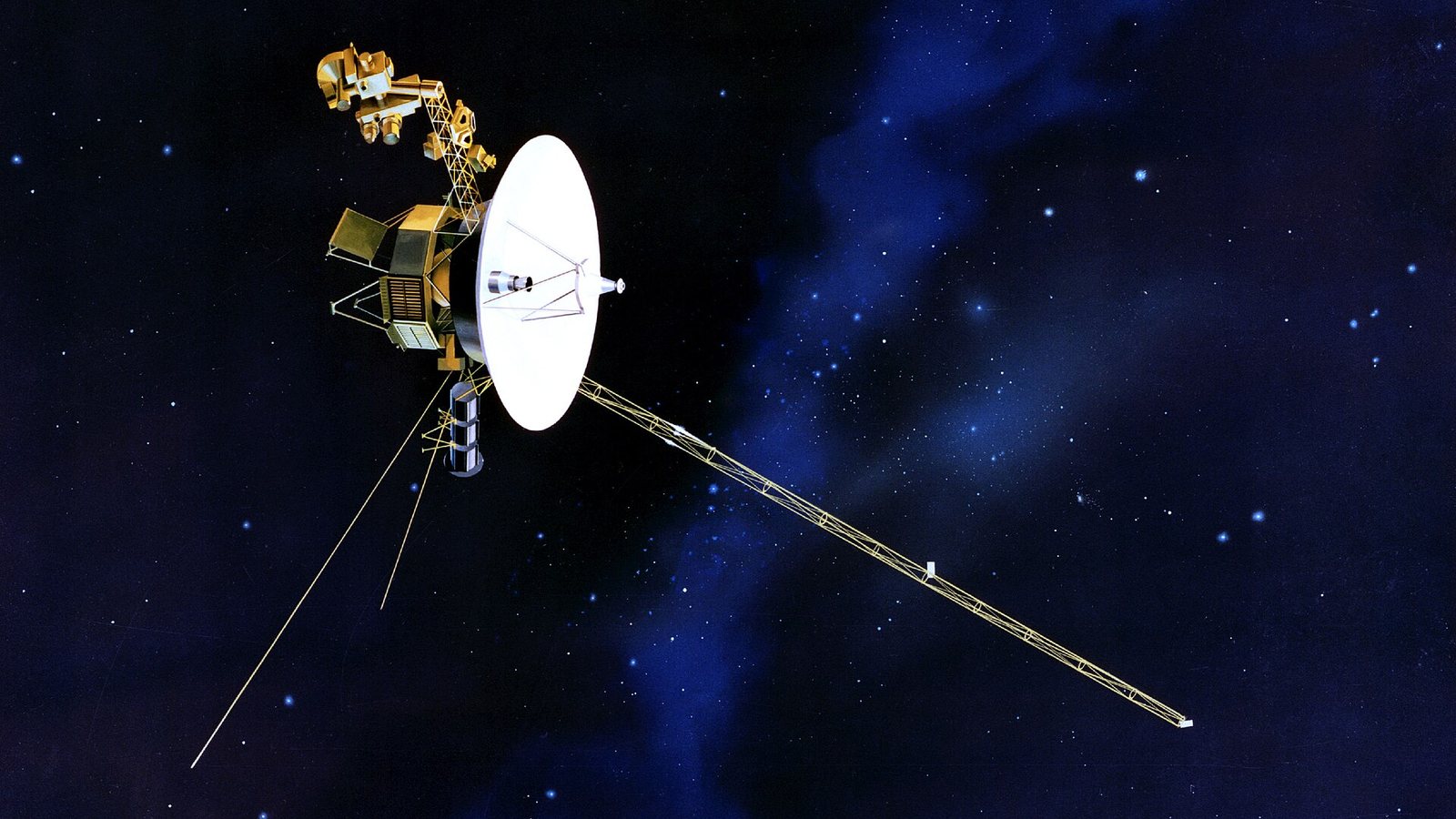
Voyager 1 passed a milestone on Wednesday that no other human-made object has reached: it is now one light-day from Earth. According to NASA, the crossing came at 5:16:07 a.m. EST on November 18, 2026, 49 years, two months and 11 days after the probe launched in 1977. A radio command sent to the spacecraft today takes a full day to arrive, and the reply takes another day to come back.
What "one light-day" means
A light-day is the distance light travels in 24 hours, about 16.1 billion miles (25.9 billion kilometers). NASA puts the figure at 16,094,799,096 miles. EarthSky, which published the exact crossing time, gives the distance as about 173 astronomical units, with one astronomical unit being the Earth-Sun distance.
To put that in scale, sunlight reaches Earth in a little over eight minutes. Light from the Sun takes roughly four hours to reach Neptune. Voyager 1 is so far out that the distance in light-travel time is now measured in days, not hours. NASA notes that the light-day is roughly 170 times the distance between the Earth and the Sun.
The spacecraft is moving at nearly 38,000 miles per hour. Even at that speed, the nearest star system, Proxima Centauri, is about 4.24 light-years away. NASA says Voyager 1 is not headed there. Its general direction points toward a star called Gliese 445, which it is expected to pass within about 1.7 light-years in roughly 40,000 years.
A probe built for five years
Voyager 1 launched on September 5, 1977, and flew past Jupiter and Saturn before heading out of the planetary region of the solar system. It crossed into interstellar space in 2012, becoming the first spacecraft to do so. Its twin, Voyager 2, launched a few weeks earlier, took the "Grand Tour" route past Jupiter, Saturn, Uranus and Neptune, and is traveling more slowly in a different direction. NASA expects Voyager 2 to reach its own one-light-day mark in November 2035.
The mission was designed to last about five years, according to PBS NewsHour. Both probes are still sending data, using a radio transmitter that PBS says draws about 23 watts.
The power problem
The real limit on the mission is energy. Each Voyager carries a plutonium power source that decays over time. According to Space.com, each probe loses about 4 watts of power a year, down from 470 watts at launch.
That has forced engineers to switch things off one by one. Most of the instruments on both spacecraft no longer work. EarthSky reports that NASA shut down Voyager 1's Low-Energy Charged Particle instrument, which measured electrons, ions and cosmic rays, in April 2026, and that it could be turned back on later. A power reshuffle earlier this year extended operations, Space.com reports, but the team describes the power margins as "very thin," and keeping the spacecraft at the right temperature is also a worry.
The probe has also had scares. Space.com says Voyager 1 recently lost contact for about 48 hours before recovering, and that engineers cannot predict future problems.
What it is still measuring
The surviving instruments keep measuring the magnetic field, plasma density and energetic particles in interstellar space. Scientists use that data to understand the heliosphere, the bubble of charged particles blown out by the Sun that helps shield the solar system from cosmic radiation. Linda Spilker, the mission's project scientist at NASA's Jet Propulsion Laboratory, framed the big question to Space.com this way: where does the Sun's influence end and pristine interstellar space begin?
Voyager 1's old discoveries still matter too. PBS notes that the mission's planetary flybys found active volcanoes on Jupiter's moon Io, evidence of a liquid ocean under Europa's ice, complex structure in Saturn's rings, a methane atmosphere on Titan and nitrogen geysers on Neptune's moon Triton.
How people marked the moment
NASA invited people around the world to flash messages toward the spacecraft with phones, flashlights and building lights after sunset on November 17, and EarthSky reports that people flashed "VGR" in Morse code. The Planetary Society held a livestream on November 18. Space.com's photo of the day shows the Empire State Building lit gold for the occasion.
Each probe also carries a golden record of sounds and images meant to represent life on Earth, which is a large part of why the mission has such a hold on the public.
What happens next
Space.com says the team expects no major operational changes before the two spacecraft reach their 50th launch anniversaries, in August and September 2027. After that, no one knows how long the probes will last. The stated plan is to keep both operating as long as possible.
For ordinary readers, the practical takeaway is simple. A machine built with 1970s electronics is still sending back readings from beyond the Sun's influence, and every year the question is less "what will it find?" and more "how long can it keep talking?"
Sources
- NASA Science: Voyager 1 — What Is a Light-Day?
- EarthSky: Voyager 1 is 1 light-day from Earth on November 17-18, 2026
- Space.com: What's next for NASA's interstellar Voyager 1 probe after passing 1 light-day from Earth?
- PBS NewsHour: What we've learned from Voyager 1 as it reaches extraordinary milestone